|
THE VIETNAMESE FLAG
|
|

|
INTRODUCTION
Like the Stars and Stripes, the Vietnamese flag is
laden with symbolism and historical meaning, which makes Vietnamese American
feel a great emotional bond with its "colors".
Visit any Little Saigon around the world, and one
is likely to see a flag displaying "three horizontal red stripes on a
golden yellow background" fluttering proudly against the blue sky. Ask
your friend, neighbor, student, or client, and she or he will tell you that
those are the "colors" of Free Vietnam. It is the flag under which
hundreds of thousands of Vietnamese and Americans have fought shoulder to
shoulder and died, defending freedom against an internationally inspired and
communist-led aggressive war against the Republic of Vietnam. That the war
ended in 1975 in the subjugation of South Vietnam in no way reflects
negatively on the symbolism of those "colors". In fact, the very
survival of that flag is the survival of the idea of freedom, which remains
the ideal of all free men on earth.
|
SYMBOLISM
The Vietnamese flag has a yellow background are
three horizontal red stripes along its entire length. The "golden
yellow" has been the traditional color of Vietnam for over two thousand
years. It is also the color of earth, as understood in the universal scheme
of five elements in Oriental cosmology. The three stripes represent the three
regions of Vietnam: North, Central, and South Vietnam as united in a national
community. The vibrant red color of the stripes is the color of blood flowing
through one's veins-symbolic of Vietnam's unflagging struggle for
independence throughout its recorded history.
|

|

|
|
HISTORICAL IDENTITY
As in the case of the Stars and Stripes, the Vietnamese
flag bonds Vietnamese American with their historical past: The identity of
the "Ngàn Cé V¡ng" (Yellow Flag) has enabled the Vietnamese
people to survive as a nation even after a millennium of Chinese and French
domination. Thus, the "golden yellow" flag came to be irrevocably
associated with the Vietnamese people, their national territory, and their
history.
The flag
championed by free Vietnamese everywhere was flown for the first time at a
ceremony marking the official recognition by France of Vietnamese unity and
independence. It is a new version of a similar flag ("Cé QuÀ Ly") first flown in March 1945 when
Vietnam under Emperor Bao Dai reclaimed its independence from France. The
three-red-striped yellow flag continued to be the official flag of the
Republic of Vietnam, which was recognized by the United Nations (1950), until
April 1975.
|
|

|

|
|
CONTRAST WITH THE VIETNAMESE COMMUNIST FLAG
The "yellow star on red background" flag
of communist Vietnam (now called the Socialist Republic of Vietnam or SRV)
first made its official appearance in September 1945, when Ho Chi Minh
proclaimed the independence of Vietnam. As the United Nations and many
nations in the world including the United States now recognize the SRV, its
flag is questioned by all free Vietnamese around the world, including
Vietnamese Americans.
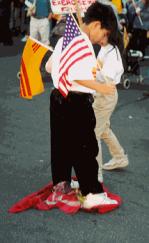
Firstly, it is the symbol of a party imposed on
the Vietnamese people since August 1945. It was the official flag of the
Indochinese Communist Party (1930-1945).
|
|
|
Secondly, it is an international flag, not a
national flag. Each point of the yellow star represents one of the five
protectorates of the Union of French Indochina: Tonkin, Annam, Cochinchina, Cambodia,
and Laos. By maintaining this flag, communist Vietnam on the one hand, harks
back to a period of French colonialism while, on the other hand, keeping
alive the imperialist ambition of an Indochinese Federation under Hanoi's
thumb.
Thirdly, it is a communist flag. The blood read
color of the background refers to the violence of class struggle and the
ultimate victory of the proletariat revolution throughout the world, as
proclaimed by international communists. But international communism is dead with
the downfall of the Soviet Union in 1991.
In
brief, the Vietnamese communist flag symbolizes an antithesis to the very
idea of freedom and peace that Vietnamese Americans and free Vietnamese
around the world want to foster in our community and in generations of
younger Vietnamese.
|
|
A CHOICE OF
HOPE AND LOVE OF FREEDOM
To Vietnamese Americans, the Vietnamese Communist
flag is a reminder of death. It is a blood-reeking flag under which some
three and a half million Vietnamese lives have been sacrificed for the
war-mongering goals of the Communist Party of Vietnam (CPV) as proclaimed in
Hanoi's national anthem, "Forward, Soldiers!" which says in part:
"We swear to tear our enemies apart and drink their blood!". Thirty
thousand landowners were lynched to death or summarily executed by Vietnamese
communists before the 1954 Geneva Agreement. Some 1,200 civilians were shot
and buried alive during the 1968 Tet Offensive. Fifty thousand religious
leaders and political prisoners have been executed in "re-education"
camps since 1975.
|
|
Most Vietnamese Americans, having fled persecution
and reprisals, find the display of the "yellow star on red
background" flag insulting, offensive, and culturally insensitive. It is
like flying the swastika flag of Nazi Germany in the presence of
Jewish-Americans.
The choice of the Vietnamese flag affects
Vietnamese and Americans alike. Fifty eight thousand Americans laid down
their lives in the Vietnam War for a noble cause - the cause of freedom and
democracy. Witness the "three red stripes on yellow background"
flag proudly hoisted at the Vietnamese Memorial in Washington, D.C. on
Memorial Day and the Fourth of July. It is the same flag that decorates the
medals on the chests of millions of Vietnamese and American veterans of the
Vietnam War. At least 400,000 Vietnamese "boat people" died on the
high seas of starvation and drowning, in their attempt to flee communist
persecution. To the one million Vietnamese who have fled communist
totalitarianism since 1975 and have successfully resettled in "the Land
of the Free", the "three red stripes on yellow background"
flag will always be a symbol of hope and love of freedom. It is the banner
around which all free Vietnamese identify themselves and rally - as long as
the dream of a free Vietnam remains alive and well.
|
|
|
|
|

|
Trôû veà trang nhaø
|

|
Trôû veà ñaàu trang
|
|
|
|
|
|
|
